Pleasanton is known for its excellent public schools—but maintaining that excellence requires more than what the state provides. Despite high property values, our schools receive significantly less funding than many comparable districts across the country.
This gap stems from Proposition 13, the 1978 law that capped property tax increases and led to a long-term decline in school funding statewide. While home values have soared, our effective property tax rate remains one of the lowest in California, meaning state and local taxes alone cannot sustain high-quality education.
In addition, the Local Control Funding Formula (LCFF) directs more money to lower-income districts, while wealthier communities like Pleasanton receive less. The state has also shifted a greater share of pension costs to local districts, further straining budgets.
That’s why Pleasanton Partnerships in Education Foundation (PPIE) exists—to bridge the gap between what our schools need and what the state provides. Through community donations, business partnerships, and fundraising events, PPIE invests directly in programs that keep class sizes small, support teachers, expand music and wellness programs, and enhance learning for all Pleasanton students.
This year, thanks to generous community support, PPIE is funding programs and staff that directly impact every Pleasanton student, including:
Elementary music education – providing teacher salary support so every 1st–5th grader can experience music each week
Extra hours for school librarians – ensuring libraries remain open and accessible for students at all grade levels
Mental health and wellness support – staffing Wellness Centers and counseling resources at our middle and high schools
5th Grade Outdoor Education transportation – covering bus costs so every student can attend this milestone learning experience
Student and Educator Innovation Grants – funding creative projects that inspire learning and engagement in and beyond the classroom
Together, these investments strengthen our schools, support our educators, and enrich the educational experience for more than 13,000 Pleasanton students.
The key to Pleasanton’s success is the strong partnership and financial support from PPIE and each school’s PTA. Although Pleasanton Unified School District is one of the top-ranked districts in California, state and local taxes alone do not provide adequate funding for the excellent education we want for our students. PPIE and our PTAs raise funds to help bridge this gap, giving Pleasanton schools the additional resources needed to keep all our elementary, middle, and high schools strong.
Donations to PPIE fund teachers and essential districtwide programs, including elementary music education, librarian hours, mental health and wellness support, 5th grade Outdoor Education transportation, and student and educator innovation grants. These programs can only be funded at a district level.
Donations to your school’s PTA fund community-building activities, events, teacher and staff appreciation, classroom support, equipment, and supplies. These items are funded at the school level.
PPIE and our PTAs are only possible with your financial support.
PPIE suggests an annual donation of $750 per student or $1,500 per family, but every gift—no matter the size—makes a difference. Our goal is 100% participation from Pleasanton families, because when everyone contributes, every student benefits.
Your donations fund critical programs and supplemental staff that ensure a high-quality education not fully supported by state funding through PPIE’s Giving Fund.
There are many ways to get involved:
- Become a volunteer and get involved with events such as our Fall Gala or the Run for Education
- Represent your school as a PPIE Ambassador to be part of the decision-making process and part of the fun!
- Make a Donation – every donation makes a huge difference for our students.
- Use our matching fund tool to see if you’re eligible to request Matching Funds from your employer
When our community comes together through PPIE and our PTAs, we ensure that Pleasanton schools remain strong—today and for generations to come.
Pleasanton schools are among the highest-rated in California, yet they receive less funding from the state than many other districts. Understanding why requires looking at how public school funding works—and how our community helps make up the difference.
Public school funding is determined by California’s Local Control Funding Formula (LCFF), which provides more resources to districts serving higher numbers of low-income students, English language learners, or foster youth. Because Pleasanton has fewer students who meet these criteria, our district receives less per-student funding than many other communities.
This lower funding, combined with rising operating costs, makes it difficult to sustain the high-quality educational programs our students, families, and community value. To maintain the academic excellence that attracts families to Pleasanton and strengthens our community, additional local support is essential.
Pleasanton schools receive funding from several sources — state funds (which include a portion of local property taxes), federal funds, supplemental donations from organizations like PPIE, and occasionally local bond or parcel tax funds, if approved by voters.
See the infographic below, developed by Pleasanton Unified School District (PUSD) and PPIE, to better understand how education funds flow through our district. To dive deeper into school finance in California, visit Ed 101.
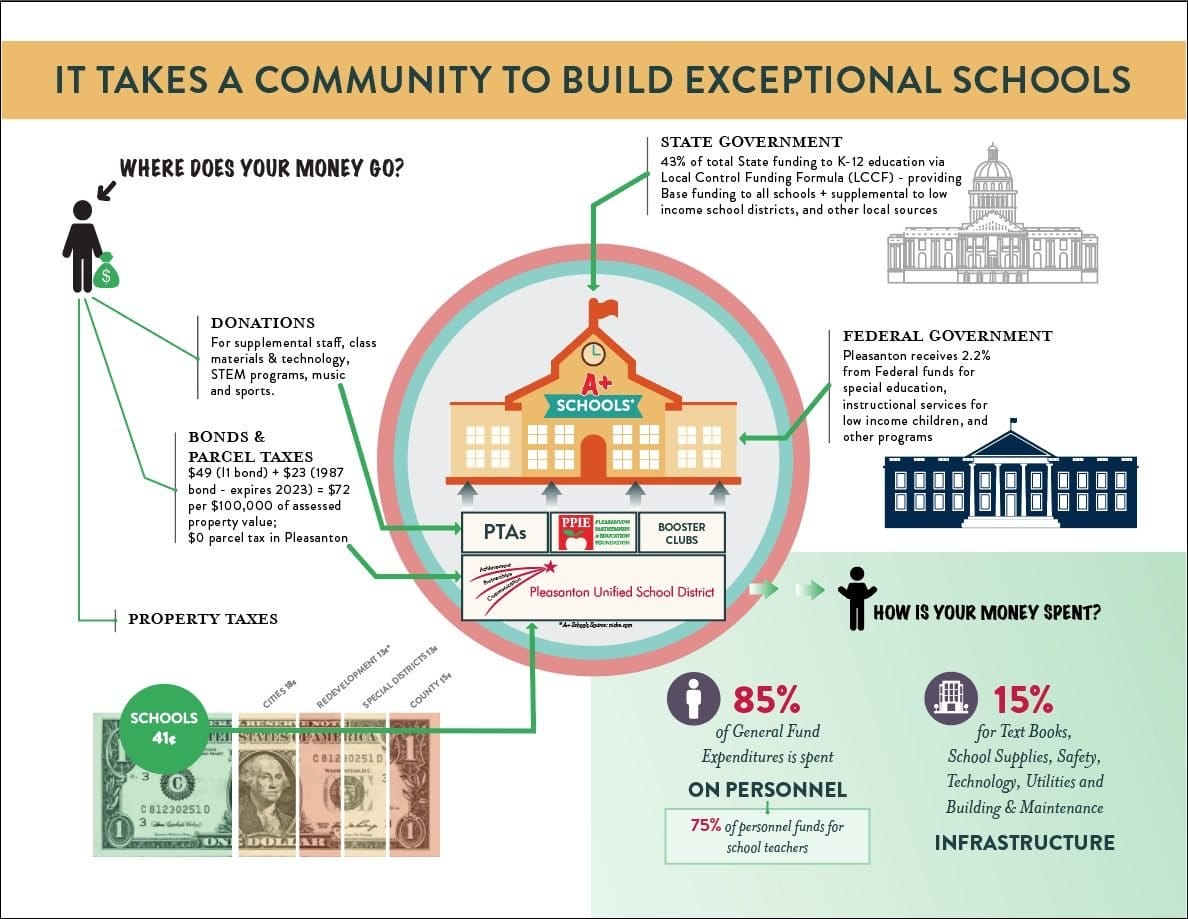
In California, property taxes go to the state’s general fund rather than directly into the community to fund the schools. The money is then allocated by the legislature and governor, along with other areas of state spending. School parcel taxes and bond measures may directly fund schools. PLeasanton passed a bond in
Pleasanton schools are funded through a mix of state and federal dollars, community donations, and voter-approved bonds. Unlike some nearby districts, Pleasanton does not currently have a parcel tax, which could provide ongoing local funding for programs and staff.
School bonds (like Pleasanton’s Measure I [2022] and Measure I1 [2016]) are approved by voters and can only be used for capital improvements — things like building or modernizing classrooms, upgrading technology and safety systems, repairing roofs, or improving facilities.
Bond funds cannot be used to pay for ongoing expenses such as teacher or staff salaries, classroom programs, or supplies.
Bonds help maintain and improve the physical learning environment for students.